- Responding to customer requests, 2016 Ford F-150 with the
5.0-liter V8 engine will offer a gaseous-fuel prep option, making it the
only light-duty pickup capable of running on compressed natural gas or
propane
- Ford has sold more than 57,000 vehicles prepped to run on clean,
low-cost compressed natural gas and propane – seven times more than all
other major U.S. automakers combined – since 2009
- Ford has the broadest portfolio of natural gas and propane
offerings, including 2016 F-150 and Super Duty trucks, and Transit and
Transit Connect vans and wagons
- Ford Qualified Vehicle Modifiers offer a wide
variety of CNG options to help customers find the best, most
cost-effective solution to their diverse operating needs
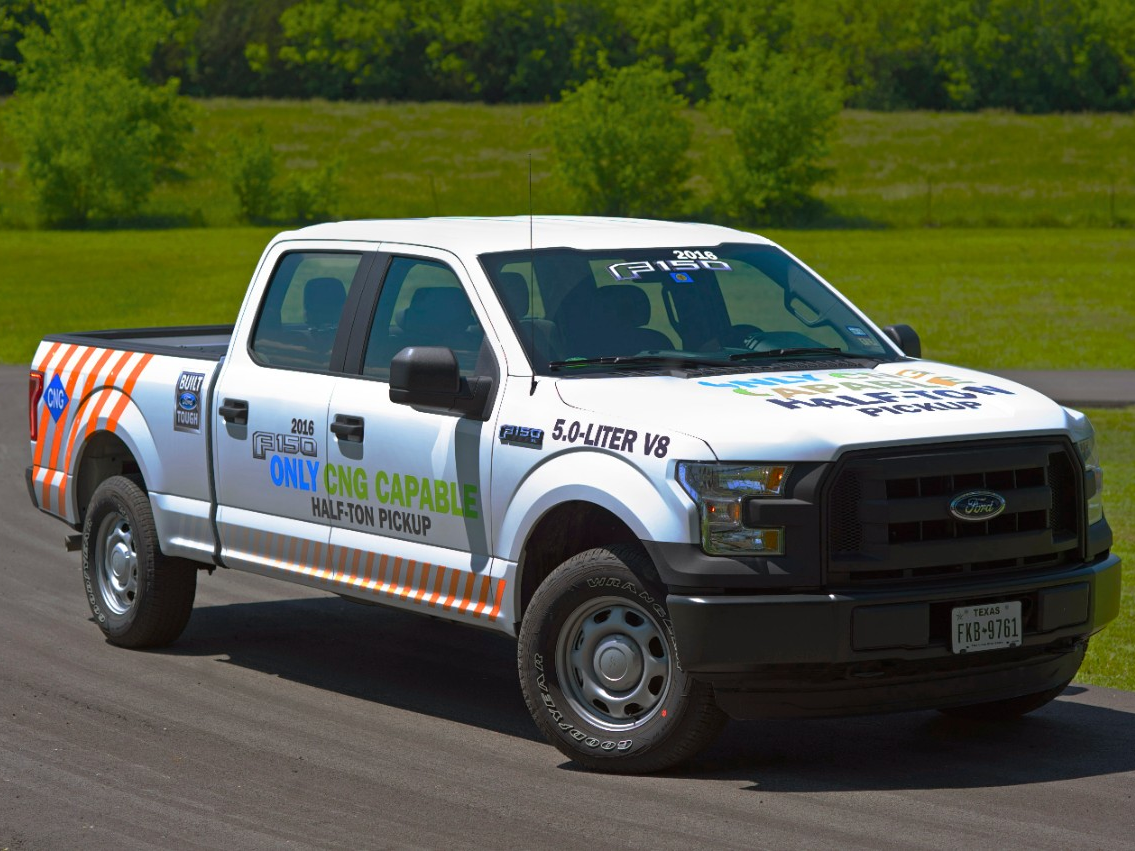
Ford, America’s truck leader, will offer the 2016 F-150 with an
available gaseous-fuel prep package that enables 5.0-liter V8-powered
models to run on clean, low-cost compressed natural gas or propane,
making Ford the only manufacturer of a CNG/propane-capable half-ton
pickup.
The 2016 Ford F-150 – the toughest, smartest, most capable F-150 ever
– with 5.0-liter V8 engine will be available to order this summer with a
factory-installed, gaseous-fuel prep package that includes upgraded
intake and exhaust valves and valve seats to ensure the engine performs
to Built Ford Tough standards customers expect.
“We surveyed customers likely to use natural gas or propane, and 72
percent told us they want to have these alternative-fuel capabilities
available on F-150 with the 5.0-liter V8 engine,” said Jon Coleman, Ford
fleet sustainability and technology manager. “We expect the
gaseous-fuel prep package will be even more popular than it was on the
2014 F-150 with the 3.7-liter V6 engine, given the capability of the
2016 F-150 5.0-liter V8.”
2016 F-150 trucks running on CNG or propane will be able to tow the
same amount as if they were running on gasoline. Payload capability is
the same as well – minus the weight of the installed CNG or propane
system. Thanks to the use of advanced light-weighting materials, the
2016 F-150 with an installed CNG or propane system can haul hundreds of
pounds more than a similarly equipped 2014 F-150.
Converting to CNG/propane
CNG/propane engine prep from the factory costs $315 before the customer
chooses a Ford Qualified Vehicle Modifier to supply fuel tanks, fuel
lines and unique fuel injectors. Upfits run approximately $7,500 to
$9,500 depending on fuel tank capacity.
CNG conversions can provide stability against fluctuating fuel prices
as well as lower vehicle operating costs for fleet administrators. CNG
sells for an average of $2.11 per gallon of gasoline equivalent, as of
April 30, 2015, and is as low as $1 in some parts of the country,
representing a significant savings compared with unleaded regular fuel,
and an even greater savings compared with diesel. The national average
for unleaded regular fuel is $2.58 per gallon, while diesel sells for an
average $2.81 per gallon, as of April 30.
Growing Demand for Ford CNG/propane-prepped vehicles
Ford has sold more than 57,000 CNG/propane-prepped vehicles – seven
times more than all other major U.S. automakers combined – since 2009.
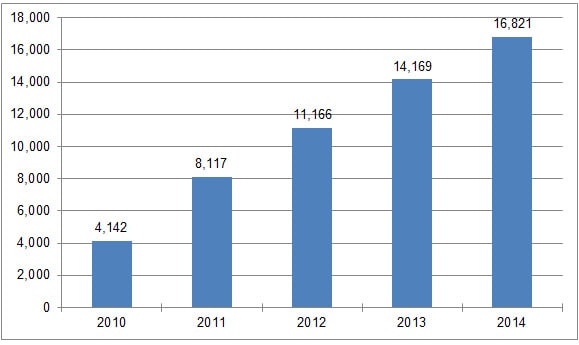
Sales have grown each of the last five years, reflecting Ford’s
commitment to sustainability and offering customers true power of choice
in alternative fuels.
Ford sold a record 16,821 commercial vehicles with CNG/propane
gaseous engine-prep packages in 2014, and 2015 is shaping up to be an
even stronger year.
“The growth in interest
for CNG/propane-prepped vehicles shows a shift in fleet customers’
mindsets,” says Dick Cupka, Ford commercial vehicle sustainability
leader. “They are becoming more forward-thinking about alternative
fuels, taking into account their total cost of ownership and looking for
ways to reduce their vehicle emissions.”
The most popular vehicles for CNG/propane prep packages are F-Series
Super Duty trucks, while prep kits for the 2014 F-150 exceeded
expectations by more than 40 percent. Ford sold more than 2,000 units in
less than a year – and announced today it expects to sell even more
gaseous fuel prep packages on the 2016 F-150 with 5.0-liter V8 engine.
The new 2015 Ford Transit has sold an impressive 836
CNG/propane-prepped vans and wagons since it became available in the
United States in June 2014. Transit is America’s best-selling commercial
van, based on total U.S. reported sales in the first quarter of 2015,
contributing to Ford’s best first-quarter overall commercial van sales
performance since 1995.
Ford Transit Connect is the only compact van sold in the United
States with a CNG/propane-prepped engine option. Sales of
CNG/propane-prepped 2015 Transit Connect vans and wagons have hit 838,
already surpassing the 762 vehicles sold in the 2014 model year.
Ford offers broadest portfolio of CNG/propane-capable vehicles
Ford sells an available CNG/propane prep option for eight of its
commercial vehicle lines, ranging from Transit Connect to F-750, making
it the broadest CNG/propane-capable portfolio of any North American auto
manufacturer. This selection has grown since 2010, when Ford offered
CNG/propane prep on E-Series vans and wagons only.
With the addition of the 2016 F-150, Ford Motor Company will offer
eight Ford commercial vehicles available from the factory with a
gaseous-fuel prep option – more than any other North American auto
manufacturer. These include:
- 2016 F-150 with 5.0-liter Ti-VCT V8
- F-250 and F-350 Super Duty pickup with 6.2-liter V8
- F-350 to F-550 Super Duty chassis cab with 6.2-liter V8 or 6.8-liter V10
- F-650 and F-750 chassis cab with 6.8-liter V10
- F-53 and F-59 stripped chassis with 6.8-liter V10
- Transit Connect van and wagon with 2.5-liter I-4
- Transit van, wagon, cutaway and chassis cab with 3.7-liter Ti-VCT V6
- E-Series cutaway and stripped chassis with 5.4-liter V8 or 6.8-liter V10
Available CNG/propane engine prep from the factory costs
approximately $315 before the customer chooses a Ford Qualified Vehicle
Modifier to supply fuel tanks, fuel lines and unique fuel injectors.
Upfits cost approximately $7,500 to $13,000 depending on fuel tank
capacity.
Ford estimates as many as 70 percent of its vehicles purchased with
CNG/propane packages are upfit before customers take delivery and
another 20 percent are upfit within a year of purchase.
Ford F-150 Qualified Vehicle Modifiers
Ford has established a rigorous qualification program for
alternative-fuel vehicle modifiers. Four of these modifiers are
committed to offering CNG or propane bi-fuel and dedicated kits for the
2016 F-150 – providing true power of choice to Ford commercial customers
who have unique vehicle requirements in different vocations:
- Altech-Eco, based in Asheville, North Carolina – CNG
- IMPCO Automotive, based in Sterling Heights, Michigan – CNG and propane
- Westport, based in Dallas – CNG
- Venchurs Vehicle Systems, based in Adrian, Michigan – CNG
Ford Qualified Vehicle Modifiers offer a wide variety of CNG and
propane options to help customers find the best, most cost-effective
solution to their diverse operating needs. Ford maintains the engine and
powertrain limited warranty (five years or 60,000 miles) for the
vehicle. The modifier is responsible for the system component warranty
and can provide additional details.
Ford maintains the engine and powertrain limited warranty (five years
or 60,000 miles) for the vehicle. The modifier is responsible for the
system component warranty and can provide additional details.
Ford Commercial Vehicle Qualified Vehicle Modifiers
A total of six Qualified Vehicle Modifiers are able to convert the full
range of Ford CNG/propane-prepped engines to run on natural gas or
propane at 36 locations across the United States:
- Altech-Eco, based in Asheville, North Carolina
- IMPCO Automotive, based in Sterling Heights, Michigan
- Landi Renzo USA, based in Torrance, California
- ROUSH CleanTech, based in Livonia, Michigan
- Venchurs Vehicle Systems, based in Adrian, Michigan
- Westport, based in Dallas
Compressed natural gas and propane
Compressed natural gas is mainly composed of methane. It is stored and
distributed in hard containers at a pressure of approximately 3,600 psi.
Approximately 85 percent of the CNG used in the United States is
produced domestically.
Another benefit of this alternative fuel is cleaner emissions. Vehicles operating on CNG can reduce tailpipe CO
2 emissions by approximately 20 percent when compared with the same vehicle operating on gasoline.